New York, NY small businesses face the same adversaries that hit Fortune 500 companies, but with a fraction of the security budget and staff. Cybercriminals know this, which is why 43% of all cyberattacks target small businesses and SMBs experienced roughly four times more confirmed breaches than large organizations in 2024 (Verizon DBIR 2025).
Express IT Guy helps NYC small businesses close the gaps before an attacker finds them. This guide covers 10 small business cybersecurity best practices, explains which vendor tools and service options fit different budgets, and gives you a ready-to-use checklist you can act on today.
Key takeaways from this article:
- 43% of all cyberattacks target small businesses, and SMBs now experience roughly 4x more confirmed breaches than large organizations, making a do-nothing stance a serious financial risk for any New York company.
- Multi-factor authentication (MFA) blocks an estimated 99.9% of automated account attacks, yet 65% of SMBs still have not turned it on, leaving credentials as the easiest door an attacker can open.
- The 3-2-1 backup rule, 3 copies, 2 media types, 1 offsite, costs under $500 per year to implement for most small firms and eliminates the leverage ransomware attackers count on.
- Employee phishing training delivers the highest ROI of any security measure: consistent simulation-based training makes staff up to 7x less likely to click a malicious link.
What Are Small Business Cybersecurity Best Practices?
Small business cybersecurity best practices are a layered set of technical controls and staff habits that reduce the most common attack surfaces: stolen credentials, unpatched software, phishing emails, and unsecured backups. For a New York, NY company, layering even six to eight of these controls together makes the cost of attack high enough that most opportunistic criminals move on to easier targets.
Think of it as a comparison shopping problem. You are evaluating which combination of controls gives you the best risk reduction per dollar spent, not trying to buy every security product on the market.
The sections below walk through each practice, name specific tools where relevant, and flag what to look for when comparing vendors or managed security service providers (MSSPs) in the New York area.
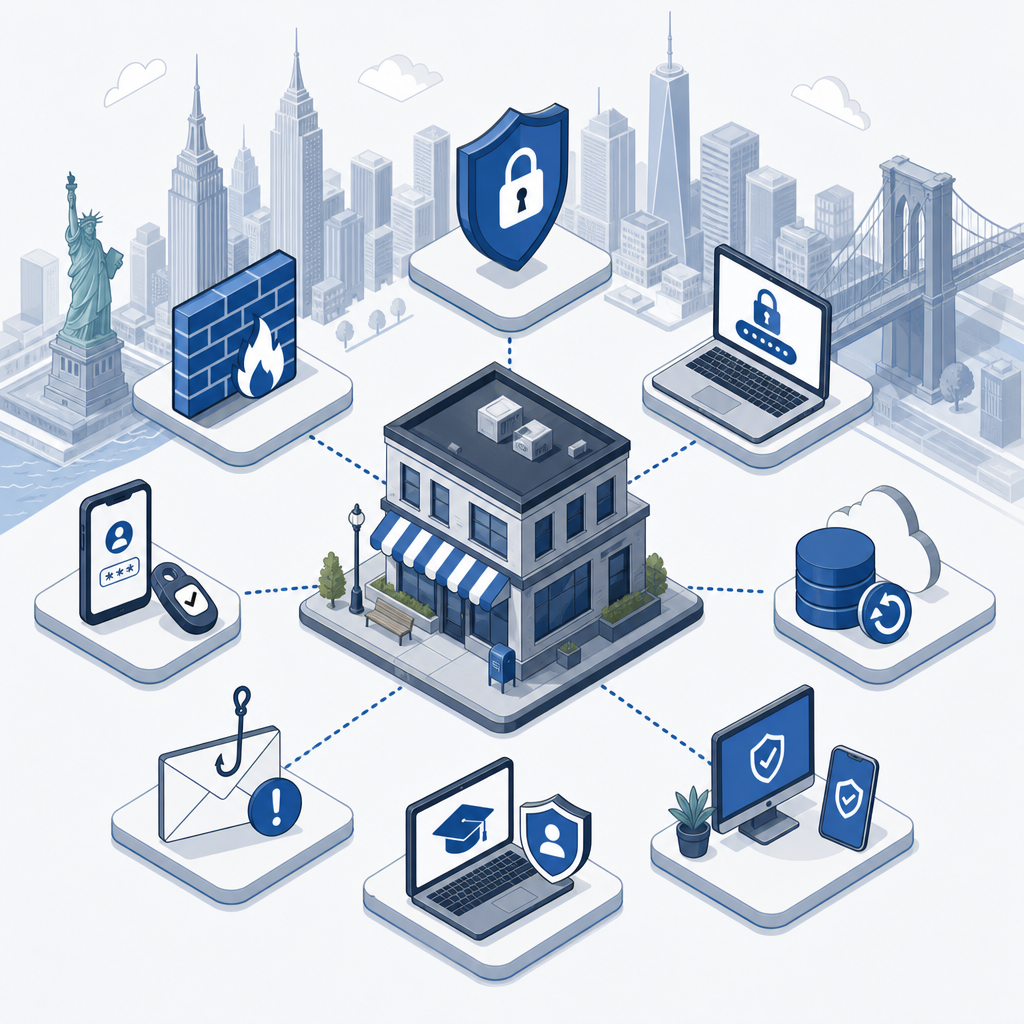
Small Business Cybersecurity Best Practices Checklist for New York, NY
- ✓Keep all software and OS patches current (enable automatic updates on all devices): Priority: Critical, reduces exposure to the 29,000+ CVEs published in 2024
- ✓Enable MFA on email, VPN, and cloud apps for all staff and contractors: Priority: Critical, blocks ~99.9% of automated account attacks (Microsoft)
- ✓Conduct recurring phishing simulation training (at least quarterly): Priority: High, consistent training makes staff 7x less likely to click malicious links (Cofense)
- ✓Implement 3-2-1 backups: 3 copies, 2 media types, 1 offsite or cloud, tested quarterly: Priority: Critical, eliminates ransomware leverage; 96% of attacks target backups (VikingCloud)
- ✓Secure office Wi-Fi with WPA2/WPA3 and isolate guest network on a separate VLAN: Priority: High, prevents lateral movement from guest or contractor devices to internal systems
- ✓Deploy a business-grade firewall, endpoint antivirus/EDR, and VPN for remote workers: Priority: High, consumer routers and free antivirus lack the controls NYC businesses need
- ✓Apply least-privilege access: limit each user to only the systems their role requires: Priority: Medium-High, limits breach blast radius if a single account is compromised
- ✓Create and test a written incident response plan (required under NY SHIELD Act for data holders): Priority: High, a tested IR plan reduces average breach cost by $232,007 (IBM)
- ✓Run an annual external vulnerability scan or penetration test: Priority: Medium, identifies ranked remediation targets before attackers find them
- ✓Obtain cyber liability insurance (only 17% of US small businesses currently carry a policy): Priority: Medium-High, covers legal fees, notification costs, and recovery expenses after a breach
Sources: Verizon DBIR 2025, IBM Cost of a Data Breach Report 2024, CISA Cyber Guidance for Small Businesses, VikingCloud, Cofense 2023, Microsoft Security 2024. NY SHIELD Act: NY General Business Law Section 899-aa.
Keep Software and Security Patches Up to Date
Outdated software is one of the most exploited entry points: threat actors actively look for open vulnerabilities like weak credentials or outdated software to break into business systems, according to CISA. For a busy New York office, the practical answer is to enable automatic updates on every operating system, application, and security tool across workstations, servers, and mobile devices.
Patch management tools from vendors like NinjaRMM, ConnectWise Automate, and Microsoft Intune can automate this across a fleet of devices for a flat monthly fee, typically $3 to $10 per device. When comparing options, prioritize any platform that shows you a real-time dashboard of unpatched endpoints so your IT team or MSSP can close gaps before attackers find them.
By the end of 2024, roughly 29,000 new CVEs (common vulnerabilities and exposures) were published, with more than 4,600 rated critical. Letting patches pile up is not a minor oversight for a NYC business that handles customer records or payment data, it is an open invitation.
Require Multi-Factor Authentication for Every Sensitive Login
MFA is the single highest-impact control a small business can deploy. Microsoft data shows businesses using MFA are 99.9% less likely to fall victim to automated account attacks, yet 65% of SMBs have still not turned it on across their accounts
.
For a New York company, turn on MFA for email, VPN, cloud apps (QuickBooks Online, Salesforce, Google Workspace), and any system that holds customer or financial data. CISA recommends phishing-resistant FIDO-based MFA (hardware security keys like YubiKey) for the highest-risk accounts, and authenticator apps with number matching as a strong second option.
Cost comparison: Microsoft Authenticator and Google Authenticator are free for basic push-based MFA. Duo Security (Cisco) starts at roughly $3 per user per month and adds granular policy controls useful for NYC businesses with remote employees or contractors who need role-based access.

Train Employees on Phishing and Social Engineering, Regularly
Phishing is the leading attack type at 33.8% of all SMB breaches, and 74% of all breaches involve the human element (Verizon DBIR 2024) . A one-time annual training session is not enough: CISA and most security frameworks call for ongoing, recurring awareness training with simulated phishing exercises
.
Staff who complete consistent simulation-based training are 7x less likely to fall for a phishing attempt (Cofense 2023). For a New York office, budget $15 to $30 per employee per year for a platform like KnowBe4, Proofpoint Security Awareness Training, or Cofense PhishMe, all of which include automated phishing simulations and reporting dashboards.
When comparing vendors, ask whether the platform lets you customize phishing templates to scenarios relevant to NYC businesses: fake IRS notices, fake e-filing emails around tax season, or fraudulent wire transfer requests that mimic your bank. Sector-specific simulations produce higher training retention than generic templates.
Back Up Critical Data Using the 3-2-1 Rule
Ransomware appears in 88% of SMB breach components (Verizon DBIR 2025), and 96% of ransomware attacks specifically target backup locations. The 3-2-1 rule is the standard defense: keep 3 copies of critical data on 2 different storage media (for example, local NAS plus an external drive), with at least 1 copy stored offsite or in a cloud backup service.
For most New York small businesses, a tested 3-2-1 backup strategy costs under $500 per year using services like Backblaze Business Backup, Acronis Cyber Protect, or Veeam. The word ‘tested’ matters here: schedule a quarterly restore drill to confirm you can actually recover files, because untested backups fail at the worst possible time.
An incident response plan paired with reliable backups reduces average breach cost by $232,007, according to IBM research. That figure alone justifies the time it takes to set up and test a backup routine before a ransomware notice appears on a Monday morning in your Manhattan or Brooklyn office.
Secure Wi-Fi, Deploy a Firewall, and Use a VPN for Remote Work
For any New York office, Wi-Fi configuration is a quick win that many businesses overlook. Configure your office network to use WPA2 or WPA3 encryption with a strong passphrase of at least 16 characters, and isolate guest Wi-Fi on a separate VLAN so a visitor’s device cannot reach your internal file shares or point-of-sale systems.
Business-grade firewalls from Fortinet, Cisco Meraki, and Palo Alto Networks include built-in VPN capabilities, content filtering, and intrusion prevention, which are features that consumer routers simply do not provide. For employees working from home or traveling on client visits across the five boroughs, a VPN ensures their traffic is encrypted end to end before it reaches company systems.
When comparing firewall vendors, ask about cloud-managed options if your IT resources are limited. Cisco Meraki’s MX series, for example, can be managed entirely from a web dashboard without an on-site engineer, and subscription pricing typically runs $500 to $1,500 per year depending on throughput needs, a fraction of what a single breach could cost a small New York business.
Additional Best Practices: Access Control, Incident Response, and Cyber Insurance
Beyond the core six controls above, four more practices round out a solid security posture. Enforce the principle of least privilege: every employee and contractor should have access only to the systems and data their role actually requires, which limits the blast radius if one account is compromised.
Create a written incident response plan so your team knows exactly who to call, what to do, and in what order when something goes wrong. New York State has its own data breach notification law (NY SHIELD Act) that requires businesses to notify affected consumers without unreasonable delay, so having a documented process is not optional for NYC companies holding resident data.
Conduct at least one annual vulnerability scan or penetration test of your external attack surface. Services from vendors like Tenable, Qualys, or local NYC-based MSSPs typically start at $500 to $2,500 for a basic external scan and give you a ranked list of remediations to prioritize.
Pair this with cyber liability insurance, only 17% of US small businesses currently carry a policy, yet a single incident can easily exceed $120,000 in direct costs for a firm with under 50 employees.
Frequently Asked Questions
What is the most important cybersecurity best practice for a small New York business to start with?
MFA is the single highest-impact first step. It blocks an estimated 99.9% of automated credential attacks and can be enabled on email and cloud apps in an afternoon
. If your New York team is fully remote or hybrid, combine MFA with a VPN so remote connections are also protected .
How much does it cost to implement cybersecurity best practices for a small business?
Basic controls, MFA, automated patch management, cloud backup, and phishing training, can be implemented for roughly $500 to $2,000 per year for a team of 10 employees. That figure is a fraction of the median SMB incident cost, which Verizon and IBM research places between $120,000 and $3.31 million depending on the scale of the breach
.
Do New York small businesses have any specific cybersecurity legal obligations?
Yes. The NY SHIELD Act requires any business that holds private information of New York State residents to implement reasonable cybersecurity safeguards and notify affected individuals without unreasonable delay after a breach.
Businesses in regulated industries such as finance or healthcare also face additional requirements under NYDFS Part 500 or HIPAA respectively.
How often should employees receive cybersecurity training?
CISA and most security frameworks recommend recurring training, not a single annual session. A practical schedule for a New York small business is quarterly phishing simulations plus at least one live or video training session per year covering current threats like business email compromise and social engineering calls.
What is the 3-2-1 backup rule and why does it matter for ransomware?
The 3-2-1 rule means keeping 3 copies of your data on 2 different storage types with 1 copy stored offsite or in the cloud. It matters because 96% of ransomware attacks specifically target backup locations, and having an isolated offsite copy means you can restore operations without paying a ransom demand.
Express IT Help’s cybersecurity services give New York small businesses access to the same enterprise-grade protections covered throughout this guide, delivered and managed by a local team familiar with the NYC threat landscape.
